Morocco Investment Charter Explained: Incentives Up to 30% and How to Apply (CRI and AMDIE)

Jeraya Team
November 14, 2026Most investors read "up to 30%" and assume Morocco will hand them 30% of their capex. Almost nobody gets that. The figure is a ceiling built from several stacked grants, and whether you reach it depends on your sector, your region and how many jobs you create. Understanding that structure before you meet the regional investment center is the difference between a realistic financing plan and a disappointing one.
This guide explains how the Investment Charter works, who qualifies, how the application runs through the CRI and AMDIE, and where foreign investors most often go wrong.

What the Investment Charter actually is
The Charter is Framework Law No. 03-22, adopted in December 2022. It replaced the 1995 charter (Law 18-95) and is implemented through a set of decrees, the first being Decree 2-23-1, plus decisions of the Head of Government. The US State Department's Investment Climate Statement for Morocco describes it as the legal basis of the country's investment support regime.
Its stated goal is to lift private investment to two thirds of total investment by 2035, which is why the grant system is generous to projects that create jobs and develop regions outside Casablanca and Rabat.
If you are still deciding whether Morocco belongs on your shortlist, start with our investor's overview of Morocco for 2026–2027.
How the "up to 30%" is built
The headline number is not a single grant. Summaries of Decree 2-23-1 describe three families of support that stack on each other:
| Support type | What it rewards | Indicative level |
|---|---|---|
| Common scheme | Job creation, plus bonuses for gender, occupation type, sustainability and local sourcing | Roughly 5–10% of the investment for jobs, plus smaller bonuses |
| Territorial scheme | Investing in less-developed regions | 10% (Category A) or 15% (Category B) |
| Sectoral scheme | Priority sectors | Sector-specific premiums |
Add them up and total support can reach 30% of the eligible investment, but not beyond it. Treat 30% as the best case, not the base case.
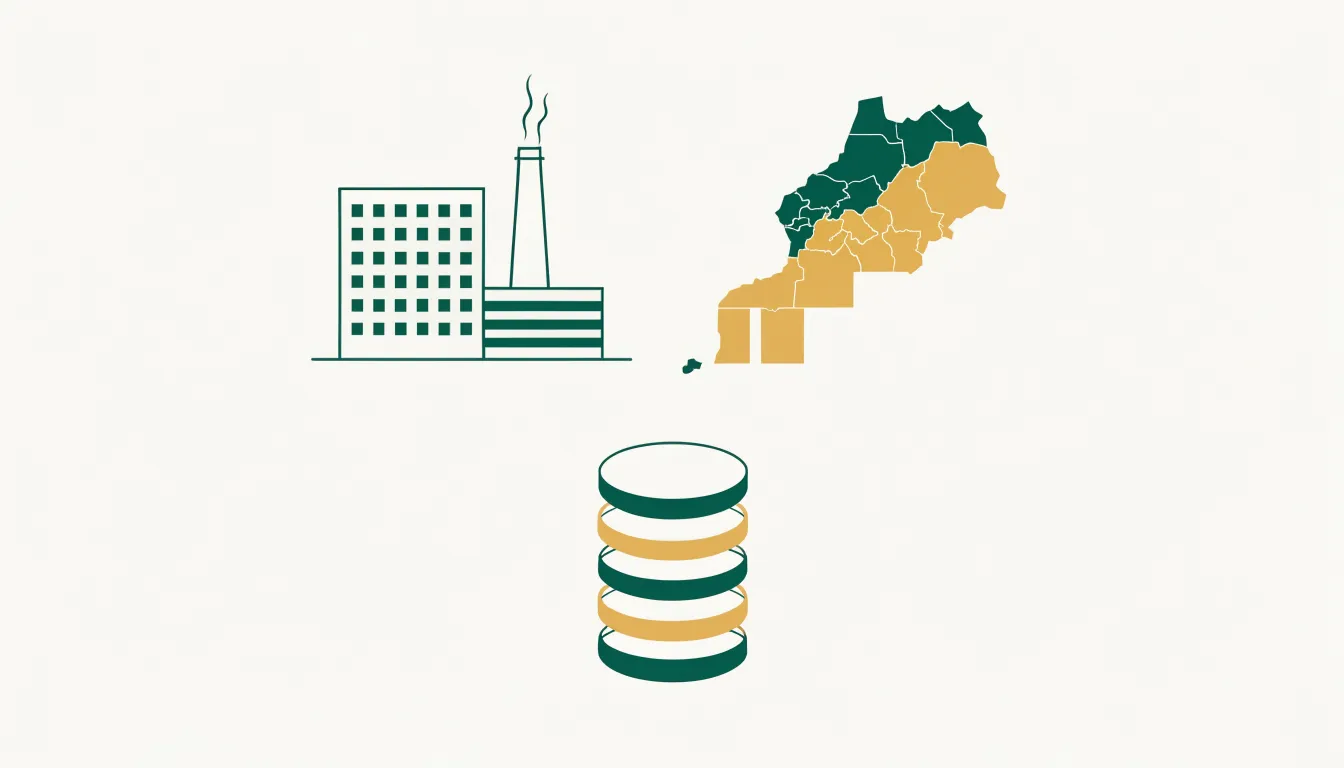
To see how this plays out, picture a hypothetical project that earns 10% for jobs, 15% for a Category B region and 5% for a priority sector. That reaches the 30% ceiling. The same project in a Casablanca location might receive roughly 10–15%.
The contrarian view: most projects will not hit 30%
Here is what most guides gloss over. The territorial premium is the largest single block, and it only applies if your plant is in a designated lower-category region. A company that wants Casablanca logistics, port access and a deep labor pool is, by definition, giving up the biggest premium. The right question is not "how do I get 30%?" but "what is the grant worth at the location my operations actually need?" Sometimes a smaller grant in the right place beats a larger one in the wrong place.
Who qualifies
The main support mechanism targets larger projects. According to the HAC guide to the Investment Charter, the usual conditions are:
- A minimum investment of MAD 50 million.
- At least 50 stable (permanent) jobs created.
- Local sourcing commitments: a minimum of 20% for agro-food and medical supplies, and 40% for other sectors.
- Strategic projects: MAD 2 billion and above, tied to national priorities such as water, energy, food or health, can negotiate bespoke support.
A caveat on the thresholds. Secondary sources disagree on the job requirement (some cite 50 permanent jobs, others describe 150 jobs as an alternative route). Confirm the current figure in the text of Decree 2-23-1 or directly with your CRI before building a business case around it.
Smaller companies are not shut out. A separate SME scheme, reported by Hespress, offers cumulative grants capped at 30% for projects below the main threshold, with a job-creation bonus, a territorial grant and a priority-sector incentive.
Tax and customs benefits on top of the grants
Grants are only part of the package. Depending on your project and any free-zone status, you may also benefit from:
- A full corporate tax exemption for exporters for up to five years, followed by a 50% reduction.
- VAT exemptions on goods registered as fixed assets.
- Reduced import duties on project equipment and materials.
CRI vs AMDIE: who does what
This is the most common point of confusion.
- CRI (Centre Régional d'Investissement): your one-stop shop. It receives and processes the file, and in practice it is your day-to-day contact. Projects below MAD 250 million are handled at regional level.
- National Investment Commission: reviews larger projects, above MAD 250 million.
- AMDIE (Moroccan Agency for Investment and Export Development): the national promotion agency. It helps foreign investors identify opportunities, connects them with the right CRI and supports high-profile projects. Think of it as the front door for overseas investors, and the CRI as the room where the file gets processed.
In short, the path runs from investor to AMDIE (orientation), then the CRI (file), then the regional or national commission (approval), and finally the investment agreement.

How to apply, step by step
- Check eligibility. Confirm your investment amount, expected permanent jobs and sector against the current thresholds.
- Choose and register your legal structure. Most foreign investors set up a SARL or SA first. Our guide to registering a company in Morocco as a foreigner compares the options.
- Prepare the file. Expect a detailed business plan, company bylaws, investment and job-creation schedules, and tax and CNSS compliance certificates.
- Submit to the CRI (or through the Ministry of Investment's online services) and request the investment agreement or grant.
- Review. The CRI or the National Investment Commission examines the file. Be ready for questions on job numbers and sourcing.
- Implement and report. Grants are tied to performance. Hitting your declared investment and job targets is what releases the money.
A short scenario: the same plant, two locations
Imagine a European components maker planning a MAD 120 million plant with 120 permanent jobs. Located in an established industrial hub, it qualifies for the common job-creation grant and any sector premium. Located in a Category B region, it adds the 15% territorial premium on top. The grant difference could be several million dirhams, but the second site may add logistics cost and recruitment friction. The winning move is to model both before you talk to the CRI. (Illustrative example, not a quote.)
Common mistakes
- Starting construction before the file is approved. Check with the CRI how pre-approval spending is treated before you commit.
- Overstating job numbers. Grants are performance-linked, so optimistic headcounts become a liability.
- Treating 30% as a given in financial models.
- Ignoring local sourcing commitments, which carry real minimums.
- Relying on secondary summaries for thresholds without checking the decree text.
FAQ
What is the Morocco Investment Charter? Framework Law 03-22, adopted in December 2022, which sets the incentives and procedures for investment in Morocco and replaced the 1995 charter.
Is the 30% a flat grant? No. It is a ceiling across stacked grants (jobs, territory, sector). Many projects receive less.
Do foreign companies get the same incentives as Moroccan ones? The Charter applies to investors based on the project, not nationality. Foreign investors should still check sector restrictions and foreign-ownership rules.
What is the difference between a CRI and AMDIE? The CRI processes your investment file regionally. AMDIE is the national agency that promotes Morocco and orients investors.
Can small projects benefit? Yes, through the SME scheme, which has lower thresholds.
How long does approval take? Official processing times are not clearly published in the sources we reviewed, so ask your CRI for a current estimate.
The takeaway
The Investment Charter is worth studying closely, but only as a model of stacked, performance-linked grants, not as a promise of 30%. Model your project at its real location, verify the thresholds against the decree, and open the conversation with the CRI early. Investors who treat the Charter as a negotiation with clear inputs, rather than a form to fill, tend to get the best outcomes.
Weighing Morocco against other options? Read how the country's trade agreements work in practice in our guide to Morocco as a gateway to Africa, Europe and the Gulf.
Sources and further reading: UNCTAD Investment Policy Monitor on Morocco's new support regime, Casainvest: The Investment Charter.