Morocco as a Gateway to Africa, Europe and the Gulf: How the Trade Agreements Work in Practice

Jeraya Team
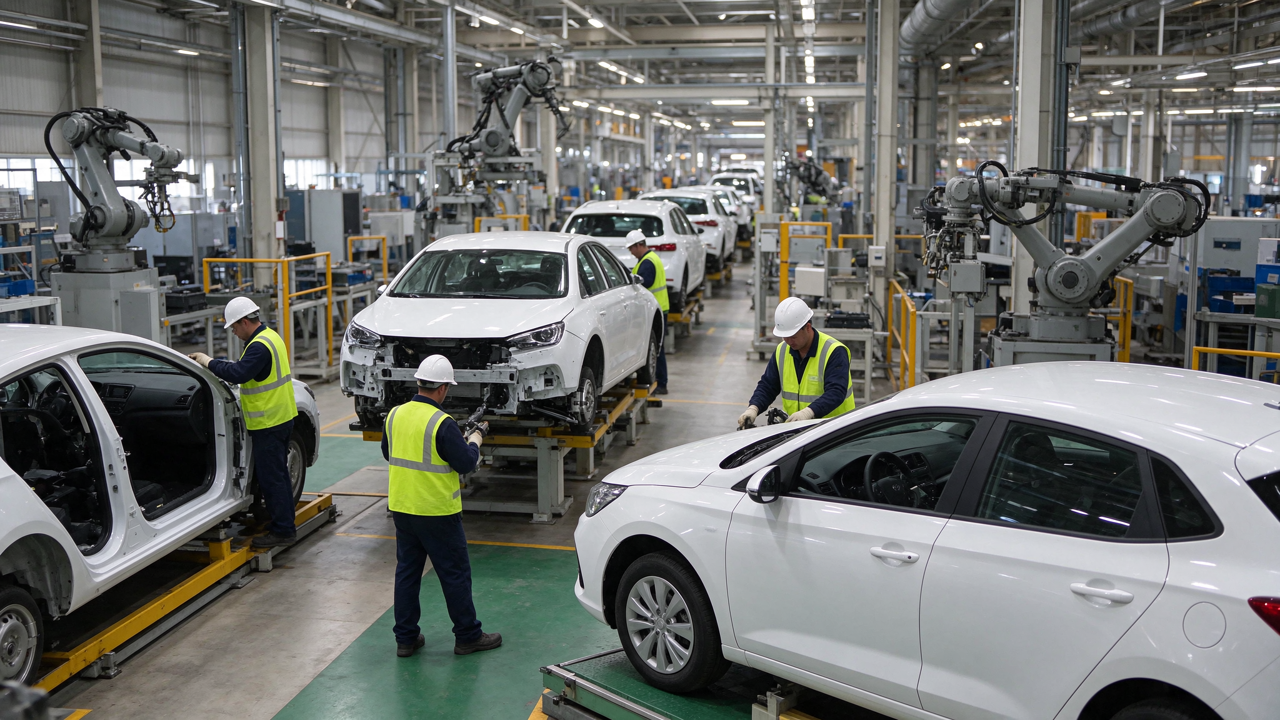
November 14, 2026In 2025, Renault built about 394,000 vehicles in Morocco, more than it built in Spain, according to reporting by Africa Intelligence relayed by Le360. A car assembled near Tangier can enter the EU market, often with no import duty. That is the pitch behind the phrase "Morocco as a gateway."
Here is the part the pitch skips: the gate is not one gate. Morocco has several separate trade doors, each with its own tariff schedule, its own paperwork and its own definition of what counts as "Moroccan." Companies that treat the gateway as a single idea tend to find out which door they actually have at the customs desk.
This guide walks through how each door works in practice, where it has been tested lately, and how to check whether your product fits through it.
What "gateway" actually means (and what it doesn't)
A free trade agreement lowers tariffs on goods that originate in a member country. It does not make Morocco a tariff-free zone for everything that passes through. If you ship a finished product that is mostly made elsewhere, the preference may not apply at all.
That is why the useful mental model is a production base with several doors, not a funnel.
Counts of how many agreements Morocco has also vary widely depending on what is counted. Morocco's finance minister said in 2024 that the country has signed over 45 free trade agreements and offers firms "direct access to a market comprising approximately one billion consumers" across Africa. The US Commerce Department's country guide instead says Morocco has preferential trade agreements with 62 countries. Both can be true, because blocs, bilateral deals and partial arrangements are counted differently. For planning, count the agreements that cover your product and your buyer, not the headline number.
The door-by-door view
| Market | Instrument | What matters in practice |
|---|---|---|
| European Union | EU-Morocco Association Agreement, in force since 1 March 2000 | Industrial goods trade duty-free if they meet origin rules; farm goods run on quotas and preferences |
| United States | US-Morocco FTA, in force since 1 January 2006 | Broad duty elimination; agricultural quotas and safeguards are updated each year |
| United Kingdom | UK-Morocco Association Agreement | Preserves the EU-era preferences; origin rules were updated in March 2026 |
| Africa | AfCFTA (ratified April 2022) | Real in law, gradual in practice; check each destination's tariff schedule |
| Gulf | Bilateral UAE FTA; CEPA concluded in 2024; Qatar talks | Bilateral, not bloc-wide; confirm status per country |
| Türkiye | Bilateral FTA, in force 2006 | Under review because of a growing trade deficit |
Europe: the door that carries the most weight
The EU is the anchor. The EU Commission reports that total goods trade with Morocco reached €60.6 billion in 2024, and that 65% of Morocco's goods exports went to the EU in 2023. The Association Agreement entered into force on 1 March 2000, and a separate 2012 deal extended liberalisation to agricultural and fisheries products.
Two real examples show how this works:
- Tomatoes. Moroccan tomato exports to the EU reached 568,370 tonnes in the 2024/25 season, while Spanish exports fell by about 35% from their 2015/16 peak. Tariff preferences and quotas under the agreement were a key lever.
- Cars. Stellantis aims to lift local integration at its Kenitra plant from 69% toward 75%. Deeper local sourcing is exactly what protects a product's "Moroccan origin" status.
Logistics back this up. Tanger Med is now the largest port in Africa and handles about 700 trucks of fresh produce a day at peak, with truck volumes on target to exceed 130,000 in 2026.
The risk investors should watch: who counts as "European"
This is the live debate of 2026. Draft EU industrial policy, the Industrial Accelerator Act, would favour products with European content in areas such as subsidies. The question for Morocco is whether its components count. One proposal would treat countries with an EU free trade agreement as "EU or equivalent". Other readings of the draft would count only parts made in the EU plus Iceland, Liechtenstein and Norway, which could cost cars assembled in Europe with Moroccan parts access to green subsidies. Reporting in October 2026 shows lawmakers pushing to include Morocco while the text was still being negotiated. Check the latest status before you rely on any equivalence.
There is a second pressure point. Chinese firms have announced about US$6 billion of investment in battery and electric vehicle component plants in Morocco. Morocco's position is that exports must satisfy strict local transformation rules to get preferential access, while some European officials worry about a bypass route.
In an analysis of origin rules, Wolfgang Lehmacher puts the shift this way: “made in” is increasingly “made through”. The question for a board is no longer whether China is in the supply chain, but how much non-local content a hub can host and still qualify.
The United States: one door, no other African country has it
The US-Morocco FTA was signed on 15 June 2004 and has been in force since 1 January 2006. Morocco remains the only African country with a free trade agreement with the US, and the pact eliminated duties on more than 95% of goods and services traded.
Two cautions. First, the trade is lopsided: the US goods trade surplus with Morocco was $3.7 billion in 2025, which keeps the agreement politically visible. Second, tariff policy has been moving. In April 2025 the US announced a baseline 10% tariff on Morocco, the lowest rate of any African country. Check the current rate for your tariff line before you model margins.
Agriculture also runs on annual quotas: Morocco publishes a yearly circular with tariff-rate quotas and safeguard duties for US farm goods.
The United Kingdom: the quiet success
After Brexit, the UK and Morocco signed an Association Agreement that preserved the EU-era preferences. Exports from Morocco to the UK have almost tripled since it entered into force. On 16 March 2026 the two sides adopted Decision 1/2026, updating the rules of origin.
Trade in goods and services reached £5.3 billion in the 12 months to March 2026, up 16.7%, and the UK is considering a public procurement chapter in a market it values at about £33 billion.
Africa: real in law, gradual in practice
Morocco ratified the AfCFTA in April 2022, so guides saying it has not are out of date. In practice, benefits depend on whether each destination country has put its tariff schedule into operation. By March 2026, just 25 countries had started preferential trade on 90% of their tariff lines.
Origin rules are the gatekeeper. AfCFTA rules sit in Annex 2 to the Protocol on Trade in Goods, and negotiations on them have been concluded and approved, even though operational implementation remains gradual. Morocco's customs administration is already training peers on them.
The Gulf and the Arab world
The picture here is bilateral, not bloc-wide. Morocco and the UAE concluded negotiations on a Comprehensive Economic Partnership Agreement in July 2024, to be signed and ratified before entering into force; non-oil trade was $1.3 billion in 2023, up 30%. Qatar and Morocco held a first round of FTA talks in November 2022. We found no GCC-wide agreement at the time of writing. Confirm the current signature and ratification status of the UAE CEPA before structuring a deal around it.
Morocco also belongs to the Agadir Agreement with Egypt, Jordan and Tunisia, which follows Pan-Euro-Mediterranean origin rules and allows diagonal cumulation with the EU.
A short story: the harness maker
Picture a mid-sized European maker of wiring harnesses. (This is a composite example, not a named company.) It moves final assembly to Morocco to cut labour costs and ship to carmakers in Spain and France. The first year goes well. Then a customer asks for a certificate showing the product qualifies for duty-free entry, and the finance team discovers that most of the value is still imported copper wire and connectors from Asia. After the Moroccan assembly step, the product barely clears the origin threshold.
The lesson is not that the move was wrong. It is that the origin calculation should have been done on day one, not at the first audit.
How to test whether the gateway works for you
Use a simple three-lock test before you commit capital:
- Tariff lock. Find your product's HS code in the agreement you plan to use. Is it duty-free, on a quota, or excluded?
- Origin lock. Map your bill of materials against the agreement's origin rule (value added or tariff shift). Run the numbers with realistic local content, not the target.
- Logistics lock. Check the route, transit time and port for your destination. Tanger Med sits on the Strait of Gibraltar, close to Europe; confirm the route works for Africa or the Gulf if that is your target.
Then:
- Start from the buyer, not the treaty. Name the market where you expect your first three customers.
- Keep proof of origin ready. Depending on the agreement, that means movement certificates or origin declarations, plus records for audit.
- Stress-test for rule changes. Model a scenario where the EU narrows local-content rules or a partner revises its deal, as Morocco is doing with Türkiye.
- Set up the entity with the destination in mind. Our guide to registering a company in Morocco as a foreigner compares the SARL, SA, branch and representative office.
- Plan the macro case. Our investor overview of Morocco for 2026–2027 covers growth and FDI.
- Plan hiring early. See our shortlist of hiring agencies in Morocco for foreign companies.
The counterarguments worth taking seriously
"Morocco's agreements are broad, so access is guaranteed." No. Preferences apply to originating goods, and origin rules are the hard part. The EU debate shows the rules can also change.
"Africa is the growth story." Possibly, but it is the least mature door. AfCFTA implementation is gradual, and many partners are not yet trading on full schedules.
"Free trade is a one-way benefit for investors." Morocco itself is reconsidering. It plans to review its Türkiye deal because of a deficit of about $3 billion, largely driven by Turkish fabric imports, even after a 2020 amendment that raised protection for textiles. Expect more selective deal-making, not less scrutiny.
"Everything depends on Europe." Largely true today. With 65% of goods exports going to the EU, Morocco's gateway has a heavy tilt, and diversification into the UK, the Gulf and Africa is a strategy, not yet a fact.
Frequently asked questions
How many free trade agreements does Morocco have? It depends on what you count. Morocco's finance minister has cited more than 45, and the US Commerce Department cites preferential agreements with 62 countries. Check the specific agreement that covers your product.
Can I export duty-free to the EU if I manufacture in Morocco? For most industrial goods, yes, if the product meets the origin rules. Agricultural products are subject to quotas and preferential arrangements.
Does Morocco have a free trade agreement with the United States? Yes. It has been in force since 1 January 2006, and Morocco is the only African country with one.
Is Morocco part of the African Continental Free Trade Area? Yes, it ratified the agreement in April 2022. Practical benefits depend on each partner country's tariff schedule and on meeting AfCFTA origin rules.
Is there a free trade agreement between Morocco and the Gulf Cooperation Council? We found no GCC-wide agreement. Morocco has a bilateral arrangement with the UAE, with a new CEPA concluded in 2024, and held FTA talks with Qatar.
What is a rule of origin? It is the test that decides whether a product counts as made in a partner country. If it fails, the preferential tariff does not apply.
The takeaway
Morocco's advantage is real, but it is a portfolio of doors, not a gateway you walk through by default. The firms that benefit are the ones that decide the destination first, check the rule of origin for their own bill of materials, and plan for the rules changing. Do those three things before you sign a lease, and the agreements become an edge rather than a footnote.
This article is general information, not legal or customs advice. Confirm tariff lines, origin rules and agreement status with a customs specialist before you commit.