HR Services in Morocco: A Complete Guide for Foreign Companies

Jeraya Team
November 22, 2026The SMIG, Morocco's minimum wage, is about 3,423 MAD a month in 2026. Most foreign companies read that number and decide that hiring in Morocco is cheap and simple.
They are right about the first part only. The salary is rarely what goes wrong. The problems come from everything around it: a CNSS declaration filed late, a fixed-term contract the courts treat as permanent, a dismissal letter sent without a hearing, or a foreign manager who starts work before the Ministry of Labour has approved their contract.
This guide explains how HR works in Morocco for a foreign company in 2026. It covers the legal structure, payroll and social security, contracts, work permits, dismissals, and the new strike law. It also explains when to handle HR yourself and when to outsource it. Every figure is sourced, and the article ends with a checklist and an FAQ.
Who this is for: founders, COOs and HR leads at European, Gulf, African or North American companies that are opening an office, a delivery center or a sales team in Morocco, or that already have one and want it fully compliant.
Why Morocco, and why HR now matters more
Morocco is no longer a niche destination. According to the Ministry of Digital Transition, the offshoring sector alone employed about 148,500 people and generated MAD 26.22 billion in service exports at the end of 2024. The government's renewed strategy targets about 270,000 jobs and close to MAD 40 billion in exports by 2030 (TechAfrica News). Automotive, aerospace, renewable energy and agri-food are growing as well. Our overview of the best sectors for foreign investors in Morocco covers them in detail.
There are plenty of people to hire. The High Commission for Planning (HCP) reported a strict unemployment rate of 10.5% in Q3 2026, and 30.5% among people aged 15 to 24 (Trading Economics, citing HCP). Finding candidates is not the hard part.
What has changed is the level of scrutiny. Payroll in Morocco is moving to digital declarations. Tax and CNSS controls are tighter, and a strike law took effect in 2025 after decades without one. A company that ran its first ten Moroccan hires on spreadsheets could do so in 2018. Doing the same in 2026 is a real risk.
A short story: the 4-month surprise
This is an illustrative scenario that combines situations common among foreign entrants.
A Paris-based SaaS company opens a 12-person support team in Rabat. The founders hire quickly. They use fixed-term contracts "to keep things flexible", run payroll in a spreadsheet, and plan to send a French team lead down "next month".
Four months later, three problems arrive at once:
- The team lead still can't legally start. A foreign employment contract needs an ANAPEC certificate and a visa from the Ministry of Labour through the TAECHIR platform. The whole process often takes 3 to 5 months, and the contract only takes effect on the date of the visa (Upsilon Consulting).
- The fixed-term contracts are a liability. Moroccan law allows a CDD only in specific cases. The role was a permanent support job, so the contracts can be requalified as permanent (CDI).
- The CNSS figures don't match. The spreadsheet applied the 6,000 MAD cap to every contribution. The cap applies to only one contribution line, so the company has been under-declaring.
None of these problems is expensive by itself. Together they cost the company a quarter, damage team morale and lead to a difficult talk with the board. Each one could have been avoided with an hour of planning at the start.
Step 1: Choose your legal structure (it decides everything else)
Before payroll, before contracts, you must answer one question: who will be the legal employer in Morocco?
As a rule, a foreign company with no presence in Morocco cannot hire Moroccan employees directly. In practice, it has three options:
| Option | How it works | Best for | Watch out for |
|---|---|---|---|
| Your own Moroccan entity (SARL, SA, branch) + outsourced HR services | You are the employer. A local provider runs payroll, CNSS, contracts and compliance for you | Teams you plan to keep and grow (roughly 5+ people, or any long-term operation) | Setup time and an accountant are required. You need the right legal form |
| Employer of Record (EOR) | A third party's Moroccan entity employs your people for you | Testing the market with 1–3 hires, or short pilots | Higher cost per employee, less control, and moving to your own entity later causes disruption |
| Contractors / freelancers | People invoice you directly | Truly independent, project-based work | Risk of misclassification if they work like employees (fixed hours, your tools, one client) |
The contrarian take: EOR is not always the "safe" first step
Many guides present EOR as the default low-risk entry. For a long-term team, we think that view is often wrong.
- An EOR is a monthly cost per person, with no end date. A small local entity combined with outsourced payroll is often cheaper from roughly the fifth employee onwards.
- Your entity is what lets you use Morocco's investment incentives, which can reach up to 30% of an eligible investment. See our guide to the Morocco Investment Charter.
- Moving staff from an EOR to your own entity later means new contracts. If you don't handle seniority carefully during the transfer, it becomes a source of disputes.
EOR is still the right tool for a pilot. If you already know you are staying, you are usually better off setting up the entity first and outsourcing the HR work.

Step 2: Payroll, CNSS and AMO, the monthly engine
Every month, a Moroccan employer must calculate gross-to-net pay, withhold income tax (IR), and declare and pay social contributions to the CNSS (Caisse Nationale de Sécurité Sociale). Declarations and payments go through the Damancom portal.
2026 CNSS contribution rates
| Branch | Employer | Employee | Ceiling |
|---|---|---|---|
| Social benefits (pension, disability, death, short-term) | 8.98% | 4.48% | Capped at 6,000 MAD/month |
| Family allowances | 6.40% | — | No cap |
| AMO (mandatory health insurance) | 4.11% | 2.26% | No cap |
| Vocational training tax | 1.60% | — | No cap |
| Total | 21.09% | 6.74% |
Sources: Upsilon Consulting, CNSS 2026; PwC Worldwide Tax Summaries.
Two things that foreign finance teams often miss:
- The 6,000 MAD cap applies to only one line. Family allowances, AMO and the training tax apply to the full salary. A spreadsheet that caps all contributions will under-declare for every employee earning above 6,000 MAD.
- Work-accident insurance is separate. It is mandatory, but you buy it from a private insurer, not through the CNSS. Many employers also add CIMR supplementary pensions (typically 3–6% from each side), which matter a lot when recruiting senior candidates.
What employer charges really cost
Because of the cap, the employer's effective CNSS rate falls as salaries rise. At 8,000 MAD gross, mandatory employer charges are 1,507.60 MAD, or 18.8%. At 30,000 MAD, they are 13.9%.
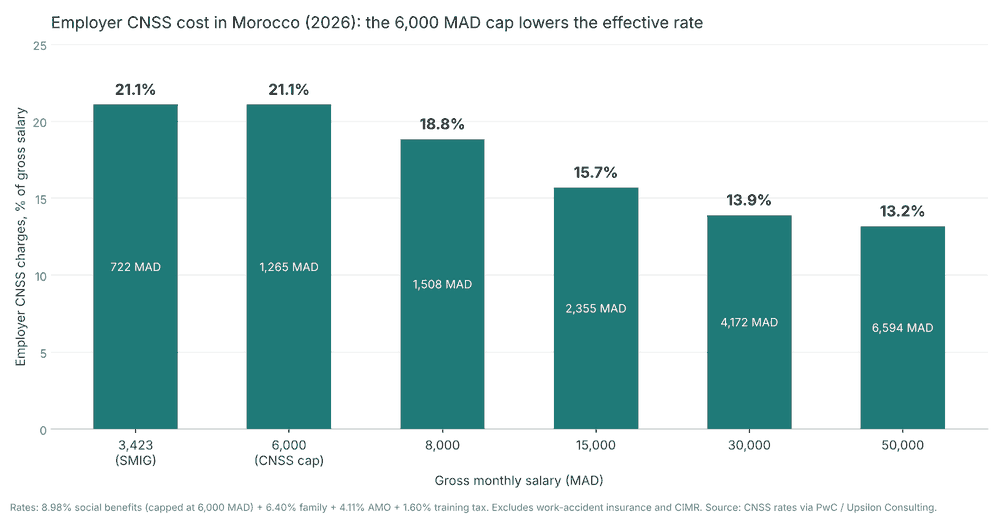
Calculated from the official 2026 rates. Excludes work-accident insurance and CIMR.
Income tax (IR)
Since the 2025 Finance Act, the IR schedule exempts the first 40,000 MAD of annual net taxable income, and the top marginal rate is 37% above 180,000 MAD (LesMRE, citing DGI). The 2026 Finance Act raised the annual family-dependant deduction to 600 MAD per dependant (PwC). The 2027 Finance Bill proposes a phased reduction of IR rates through 2031 (Upsilon Consulting). Budget for the current schedule, and check again once the bill is final.
The minimum wage
From 1 January 2026, the private-sector SMIG is 17.92 MAD per hour, about 3,422.72 MAD per month (WageIndicator). Paying below it exposes the employer to fines of 25,000 to 30,000 MAD, doubled for repeat offences (Upsilon Consulting).
Step 3: Employment contracts that hold up in court
Morocco's employment relationships are governed by the Labour Code (Law 65-99) and by any sector collective agreements.
Contract types
- CDI (indefinite term) is the default. If in doubt, a court will assume a CDI.
- CDD (fixed term) is allowed only in specific cases, such as replacing an absent employee, a temporary increase in activity, or seasonal work. Using a CDD for a permanent role is the most common mistake foreign companies make.
- ANAPEC-backed contracts are state-supported first-job contracts that reduce costs for eligible young graduates. They are useful, but they come with strict conditions.
- Freelance agreements should be used only when the person is genuinely independent.
Key terms to get right
Probation (CDI). Up to 3 months for managers, 1.5 months for office employees and 15 days for manual workers. It can be renewed once (Remote).
Working time. 44 hours a week, or 2,288 hours a year, outside agriculture. Overtime is paid at +25% between 6:00 and 21:00 and +50% at night or on a weekly rest day (Rivermate; Remote People).
Annual leave. 1.5 working days per month of service, or 18 days a year. Seniority adds extra days, up to a maximum of 30 (Payoneer).
Seniority bonus. This bonus is required by law. It is 5% of salary after 2 years, rising to 10% after 5 years, 15% after 12, 20% after 20 and 25% after 25. Budget for it from the start, because it accumulates silently on a long-tenured team.
Internal rules (règlement intérieur). Required once you reach 10 employees. You also need mandatory registers and staff-representative elections once you pass the legal thresholds.
Step 4: Hiring foreigners, start earlier than you think
Morocco's work-authorisation system is employer-led. A foreign national cannot apply for a standard work permit on their own. The usual route has four steps:
- ANAPEC certificate. This confirms that no suitable Moroccan candidate was found. Some profiles are exempt, such as certain nationalities and spouses of Moroccan citizens.
- Contract visa from the Ministry of Labour through the TAECHIR online platform (taechir.travail.gov.ma). The contract must follow the official template.
- CNSS registration and IR withholding, as for any employee.
- Residence card (carte de séjour) from the police (DGSN) where the employee lives.
The whole process often takes 3 to 5 months, and the contract is only valid from the visa date (Upsilon Consulting). Companies with Casablanca Finance City status can use a simplified route. Practical rule: begin the expatriate paperwork in parallel with company registration, not after it.
Step 5: Terminations, where most of the money is lost
Morocco protects employees well, and its labour courts apply the procedure strictly. A dismissal that is justified on the merits can still be ruled unfair if the procedure was not followed.
Notice periods (CDI)
| Seniority | Executives | Non-executives |
|---|---|---|
| Up to 1 year | 1 month | 8 days |
| 1–5 years | 2 months | 1 month |
| 5+ years | 3 months | 2 months |
Source: Remote. Collective agreements or contracts can provide more.
Statutory severance (after 6 months' service, except for gross misconduct)
The statutory severance is a number of hours of pay per year of service, accumulated in bands:
- Years 1–5: 96 hours per year
- Years 6–10: 144 hours per year
- Years 11–15: 192 hours per year
- Beyond 15 years: 240 hours per year
Worked example. An employee earning 10,000 MAD gross a month (about 52.36 MAD per hour, based on 191 hours) is dismissed after 6 years. The calculation is (5 × 96) + (1 × 144) = 624 hours, which gives about 32,670 MAD of statutory severance. That comes on top of notice and accrued leave. If a court finds the dismissal unfair, it can award damages of 1.5 months' salary per year of service, capped at 36 months (Upsilon Consulting).
The procedure you cannot skip
For a disciplinary dismissal, the employer must hear the employee within 8 days of discovering the facts. The employee may bring a staff delegate or union representative. The employer must then notify the decision by registered letter and send a copy to the labour inspector (Upsilon Consulting; CMS). Economic dismissals follow a separate procedure with prior consultation and administrative authorisation.
Step 6: Collective relations and the new strike law
For decades, Morocco's constitution recognised the right to strike, but no law defined how to exercise it. That changed with Organic Law 97-15. Parliament passed it in February 2025, the Constitutional Court validated it in March 2025, and it came into force on 24 September 2025 (Arab Trade Union Confederation; DLA Piper).
The government's position was clear. Labour minister Younes Sekkouri called it "an important step in regulating relations between the working class and employers", and ILO Director-General Gilbert Houngbo described its adoption as "very good news" (maroc.ma).
The counterargument, and why it matters to you
Not everyone agrees. Major unions organised Morocco's first general strike in a decade in February 2025 in protest (International IDEA). When the law took effect, union federations described it as an unprecedented restriction on workers' right to protest. In September 2026, the call-center union federation also asked the government to protect jobs in the offshoring sector (Morocco World News).
What this means for a foreign employer: the law gives you clearer procedures and minimum-service rules, but it does not give you industrial peace. Companies that rarely have problems are those that pay correctly and on time, hold staff elections when required, and keep their disciplinary files clean. Following the rules on payroll and procedure is your best protection against labour conflict.
Do it yourself, hire in-house, or outsource? A simple framework
We use a "4-layer HR stack" to decide what to keep and what to hand off:
| Layer | What it covers | Keep in-house when… | Outsource when… |
|---|---|---|---|
| 1. Entity & legal | Company setup, bank account, tax ID, CNSS employer registration | Never fully in-house. You always need a local accountant or lawyer | Always, at least for setup |
| 2. Payroll & declarations | Payslips, IR, CNSS/AMO on Damancom, leave and overtime | You have more than about 80 staff and a dedicated payroll officer | You have fewer than about 80 staff, several cities, or no French/Arabic-speaking finance team |
| 3. Contracts & compliance | CDI/CDD drafting, internal rules, registers, discipline, inspections | You have an experienced Moroccan HR manager | You don't have one yet. Mistakes here are the most expensive |
| 4. Talent | Sourcing, screening, salary benchmarking, onboarding | Employer brand is central and you hire continuously | You run occasional or burst hiring, or are entering a new city |
Most foreign companies with 5 to 50 employees in Morocco do best by owning layer 4 (culture and hiring decisions) and outsourcing layers 1 to 3. That combination is what Jeraya's HR services in Morocco are built for: payroll, CNSS and AMO declarations, contracts, onboarding, labour-law compliance and recruitment, in English, French, Arabic and Darija.
If recruitment is your main need, see our comparison of hiring agencies in Morocco for foreign companies.
Your 30-day HR setup checklist
Week 1: Structure
- Choose entity vs EOR (see the table above)
- If entity: register the company and get your tax ID, RC and ICE
- Start ANAPEC/TAECHIR applications for any foreign staff now
Week 2: Registrations
- Register as an employer with the CNSS and open Damancom access
- Take out work-accident insurance
- Decide on CIMR and any private health top-up for senior roles
Week 3: Documents
- Use CDI templates by default and CDDs only with a written legal reason
- Set up an onboarding pack: ID, CNSS affiliation, bank details, signed contract
- Prepare internal rules if you will reach 10 employees
Week 4: First payroll
- Load salaries and check them against the SMIG
- Run a test gross-to-net calculation, checking the CNSS cap logic and IR brackets
- File the CNSS declaration and pay contributions on time, then reconcile
To reduce the manual work on recurring tasks such as leave requests, document collection and reminders, see 10 business processes you should automate today.
Frequently asked questions
Can a foreign company hire employees in Morocco without a local entity?
Not directly in most cases. You either set up a Moroccan entity (SARL, SA or branch) or use an Employer of Record, whose Moroccan entity employs the staff for you. Contractors are a third option, but only for genuinely independent work.
How much does an employee really cost in Morocco in 2026?
Add about 13% to 21% to the gross salary for mandatory employer CNSS charges. The percentage depends on salary because of the 6,000 MAD cap. Then add work-accident insurance, any CIMR pension and the seniority bonus over time. For a 15,000 MAD gross salary, mandatory employer charges are about 2,355 MAD a month.
What does an HR services provider in Morocco typically handle?
Usually monthly payroll and payslips, IR withholding, CNSS and AMO registration and declarations on Damancom, employment contracts and amendments, onboarding, compliance (internal rules, registers, disciplinary procedures, labour inspection support) and, optionally, recruitment. See what's included in Jeraya's HR services.
How long does it take to hire a foreign employee in Morocco?
Usually 3 to 5 months from the ANAPEC step to an approved contract, followed by the residence card. Start in parallel with company setup.
Can I use fixed-term (CDD) contracts to stay flexible?
Only in the cases the Labour Code allows, such as replacements, temporary peaks in activity or seasonal work. A CDD used for a permanent role can be requalified as a CDI, with all the protections that come with it.
Is it expensive to dismiss someone in Morocco?
The statutory severance is predictable, at 96 to 240 hours of pay per year of service by band. Procedural mistakes are what make it expensive, because unfair-dismissal damages can reach 1.5 months' salary per year of service, up to 36 months. Follow the hearing and notification procedure exactly.
The takeaway
Hiring in Morocco is not hard, but it is procedural. The country offers a large, multilingual talent pool and serious investment incentives. In return, it expects employers to get the details right: the CNSS cap, CDI as the default contract, the 8-day hearing, and the contract visa date.
The companies that do well in Morocco don't necessarily have the biggest HR teams. They set up the right structure on day one and hand the routine compliance work to people who do it every month.
If you are planning a team in Morocco, or want an audit of the one you already have, talk to Jeraya's HR team. We can review your setup and give you a fixed monthly price.
This article is general information, not legal or tax advice. Rates and rules are current as of November 2026. Check them with a qualified professional before you act.